Automating the Boring Part of Studying: How I Passed AWS CloudOps with Spaced Repetition + an Autonomous Agent
TL;DR
- Passed AWS Certified CloudOps Engineer – Associate (SOA-C03) on the first attempt — 853 / 1000.
- I still bought a normal exam-prep course (Tutorials Dojo). AI didn't replace studying.
- What it replaced was the tedious manual review I used to do by hand: tracking which questions I got wrong and dragging myself back to them.
- The honest MVP wasn't the AI — it was spaced repetition. The agent and tooling just removed every excuse not to do it.
- The stack: a custom Firefox extension that captures every question I miss → an autonomous agent on an always-on Oracle Cloud VM that turns those misses into flashcards overnight → Obsidian + the spaced-repetition plugin where I review them. All glued together with Git.
- This worked for me. It is not a guarantee for you — the tooling is scaffolding around a habit, and the habit is what passes the exam.
1. The Real Problem Wasn't Learning — It Was Reviewing
Let me be honest up front, because this post is for engineers and they'll smell hype instantly: I bought the course. Content was never the hard part — there's no shortage of good AWS material, and Tutorials Dojo's practice exams are excellent.
The hard part, every time I've studied for something, has been the review loop. The old workflow looked like this:
- Take a practice exam.
- Get a handful wrong.
- Tell myself I'll "come back to those."
- Maybe scribble them in a doc.
- Lose the doc. Or lose the discipline. Usually both.
That manual bookkeeping — which questions I missed, when I last revisited them, whether they've actually stuck — is exactly the kind of tedious, error-prone process that I'd automate at work without thinking twice. So I automated it for studying. That's the whole idea. Nothing more mystical than that.
This time I sat the SOA-C03, which maps neatly onto my day job as a backend engineer at Blip — services that have to stay observed, recover, scale, and not waste money:
- Monitoring, logging & remediation
- Reliability & business continuity
- Deployment, provisioning & automation
- Security & compliance
- Networking & content delivery
- Cost & performance optimization
2. Two Pillars: A Talking Encyclopedia, and Spaced Repetition
Two ideas did the work. They're not equally important, and I'll say which is which.
Pillar one — AI as a talking encyclopedia (for understanding). I never asked the model "which answer is correct?" I asked "why is this correct, and why are the other three wrong?" — then I'd teach it back and let it catch my gaps. That conversation is great for understanding a concept the first time. For the genuinely hard topics — KMS keys, Kubernetes deployment strategies, cross-account access — I went deeper with Matt Pocock's AIHero "Teach Skill", which walks you down through a topic layer by layer instead of skimming.
Pillar two — spaced repetition (for retention). And here's the honest part: understanding fades, and the talking-encyclopedia dialogue alone wouldn't have passed me. What actually moved the needle was spaced repetition — reviewing flashcards on widening intervals so the things I kept missing kept coming back until they didn't. If I had to throw away every part of this setup except one, I'd keep the flashcards.
Everything else in this post — the browser extension, the autonomous agent, the nightly job — exists for one reason: to remove the friction between getting something wrong and reviewing it again at the right time. That's it. The clever engineering is in service of a boring, proven habit.
A caveat I'll repeat because it matters: this is my workflow and it fit my brain. It is not a formula. Steal the mindset — automate your review, lean on spaced repetition — not necessarily my exact stack.
3. The Architecture (a.k.a. the Friction-Removal Machine)
The setup is deliberately small and boring. Boring is what runs unattended for weeks without me babysitting it.
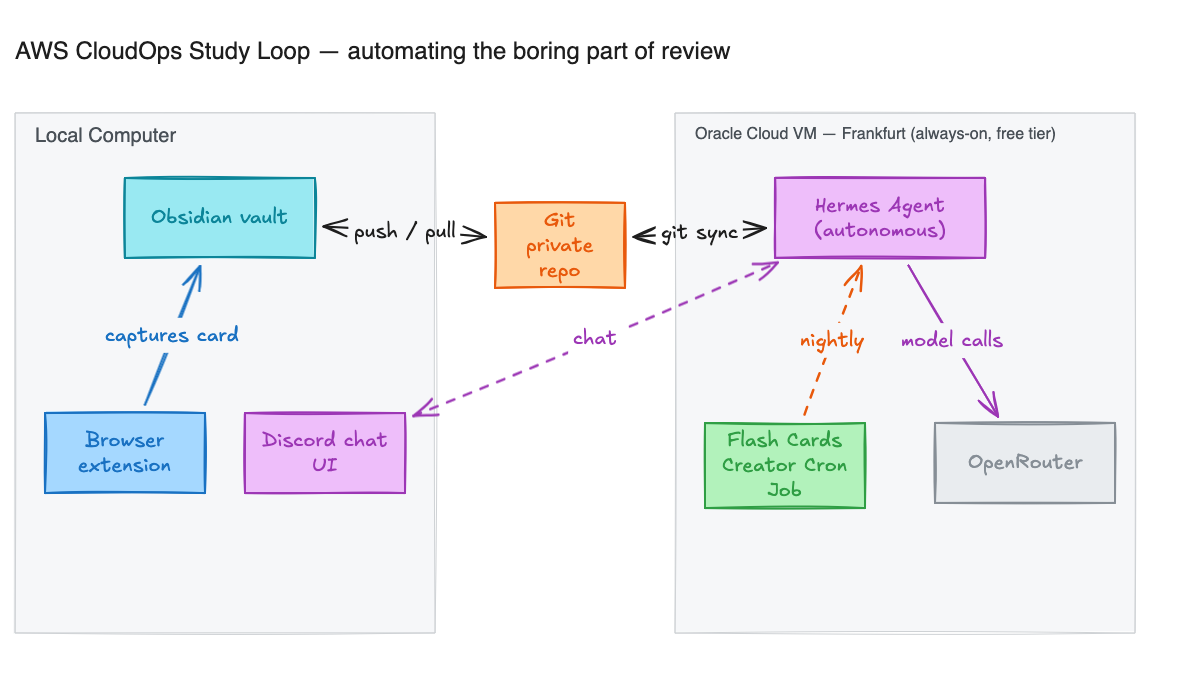
The loop in one breath: I get a question wrong → a browser extension captures it → Git syncs it to an always-on VM → overnight an agent turns my misses into flashcards → I git pull and review them in Obsidian. The agent doesn't learn for me. It just makes sure the right card is in front of me at the right time.
Step 1 — Capture: a Firefox extension that watches me fail
I built a small Firefox extension — TD Missed Question Capture (I'll publish the full source with the follow-up walkthrough) — that sits on the Tutorials Dojo practice exams.
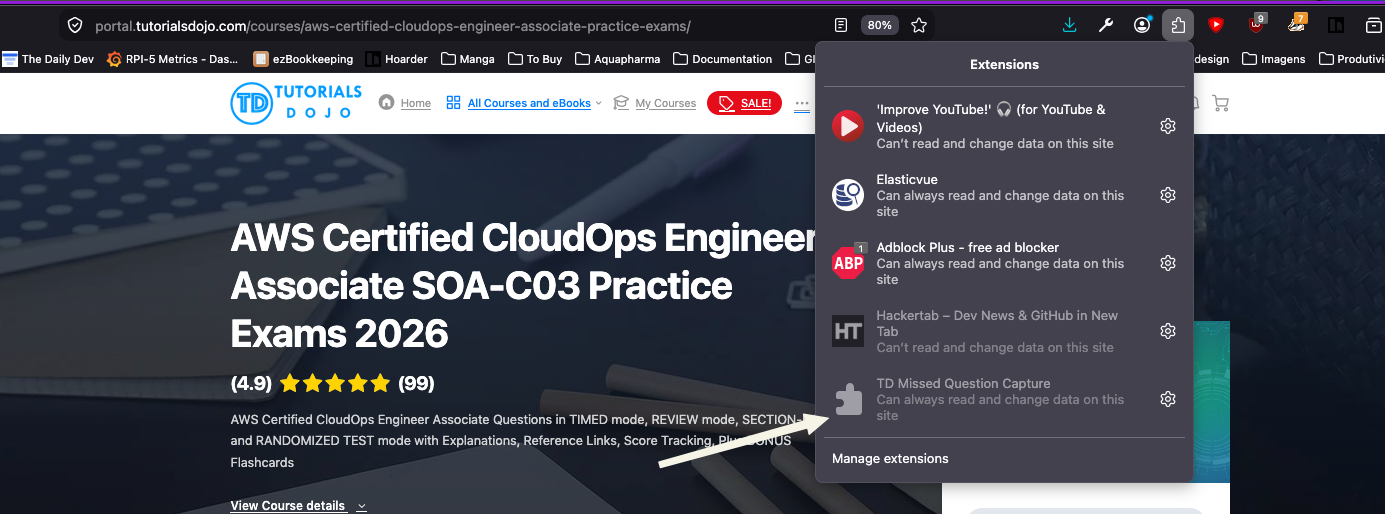
A disclaimer before you read the snippets: please avert your eyes from the code. This thing was fully vibe-coded in one sitting. I was the only user, I wanted a throwaway, and the entire goal was to automate the learning loop — not to spend an afternoon crafting a beautiful extension. It's ugly, it works, and for a single-user throwaway that's exactly the right amount of effort.
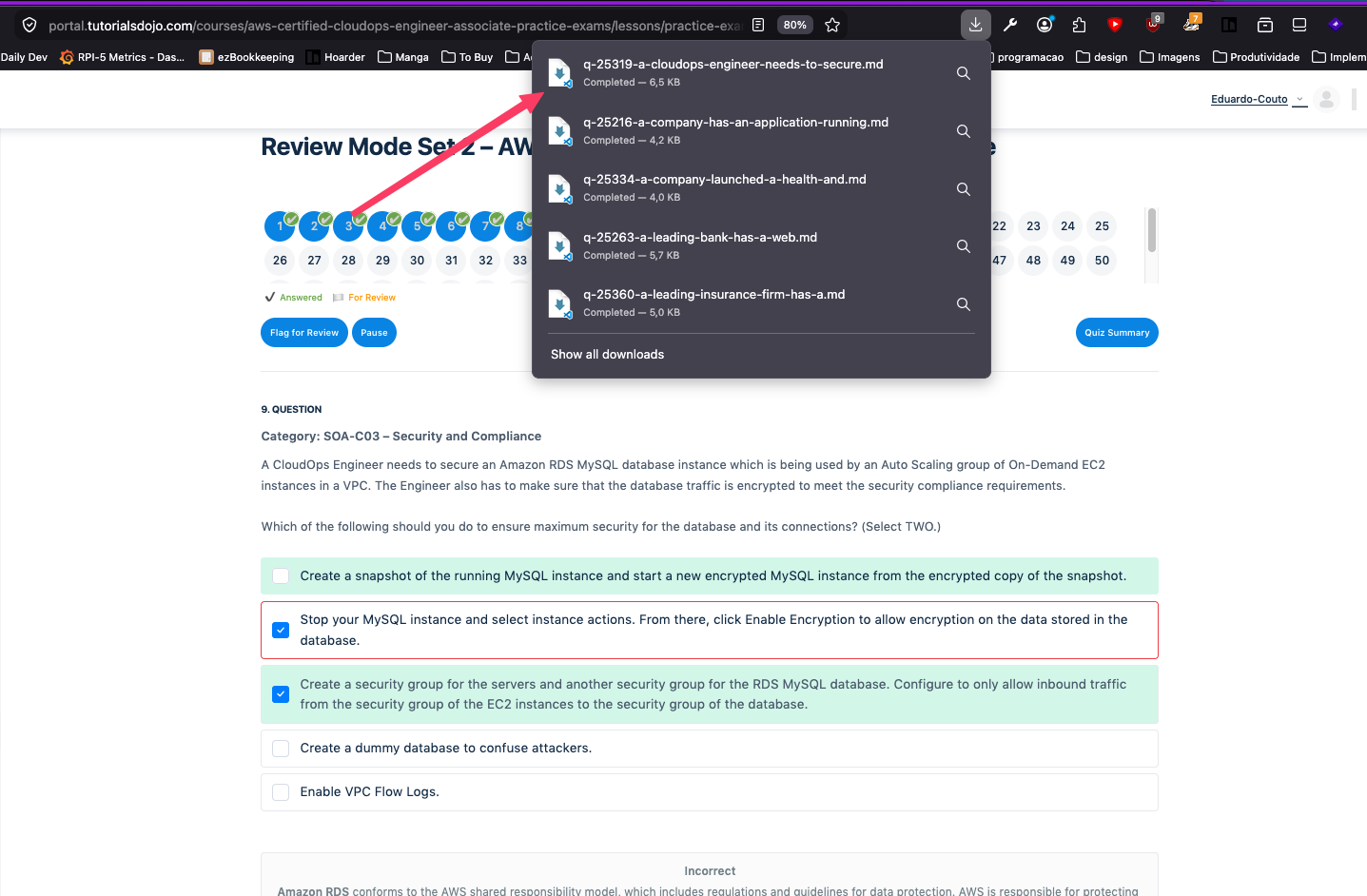
It watches the quiz DOM, and the moment I pick a wrong option it captures that question — no clicking "save," no copy-paste:
// content.js — only capture questions where I picked a wrong option
function shouldCapture(payload) {
  return payload.options.some((option) => option.isUserWrongPick);
}
// ...
seenQuestionIds.add(payload.questionPostId);
runtime.sendMessage({ type: 'CAPTURE_QUESTION', payload });
console.info(`[td-missed] captured Q${payload.questionPostId}`);
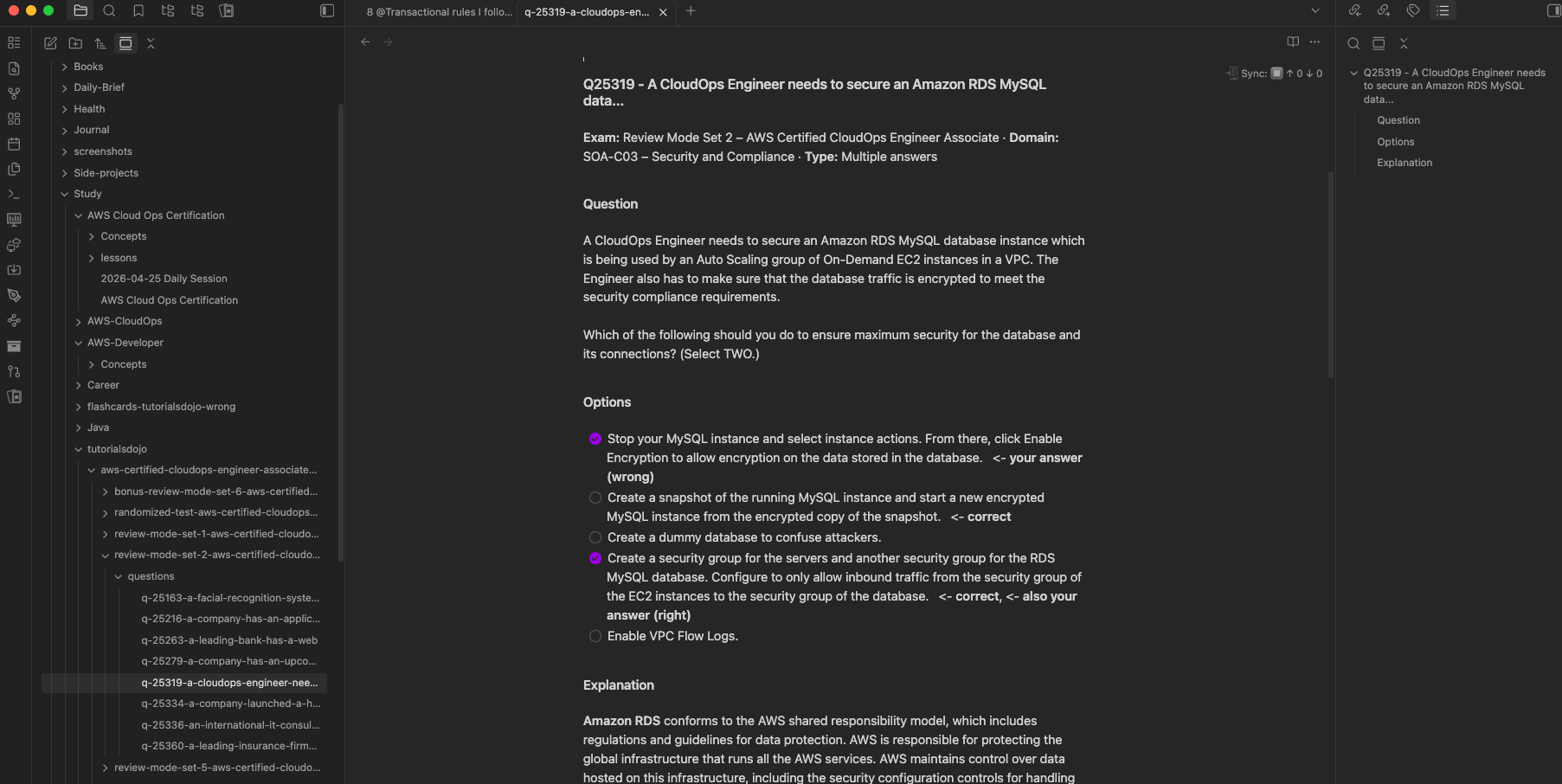
Each miss is written straight into my Obsidian vault as a markdown note — question, every option (with my wrong pick and the correct one marked), and the full explanation:
// formatter.js — mark each option with what I picked vs. what was right
if (option.isCorrect && option.pickedByUser) {
  markers.push('**correct**', '**also your answer (right)**');
} else if (option.isCorrect) {
  markers.push('**correct**');
} else if (option.pickedByUser) {
  markers.push('**your answer (wrong)**');
}
The result, sitting in Obsidian seconds later — my wrong answer and the correct one called out, with the official explanation underneath:
Step 2 — Generate: an autonomous agent builds the flashcards overnight
The vault is a single Git repo, synced to an always-on Oracle Cloud free-tier VM in Frankfurt. On that VM runs an autonomous agent (built on the Hermes Agent framework, driving models via OpenRouter + Claude Pro). A nightly cron job — daily-evening-review-job — reads every wrong-question note I captured that day and turns each one into a spaced-repetition flashcard, commits the result, and reports back to me on Discord:
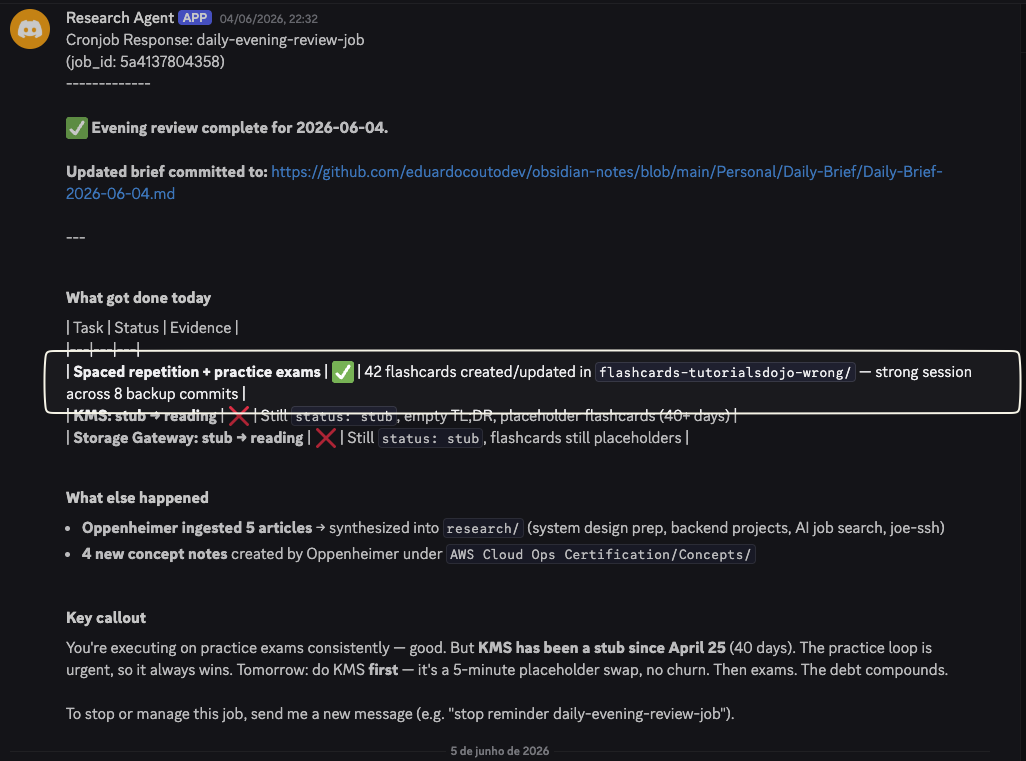
42 flashcards created/updated in
flashcards-tutorialsdojo-wrong/— strong session across 8 backup commits.
That's the entire point of the agent: if I grind through practice exams one day, then the next day I know a fresh batch of flashcards is already waiting for me — I can't run away from my errors. My only manual job from here is to actually review them.
Step 3 — Review: spaced repetition in Obsidian
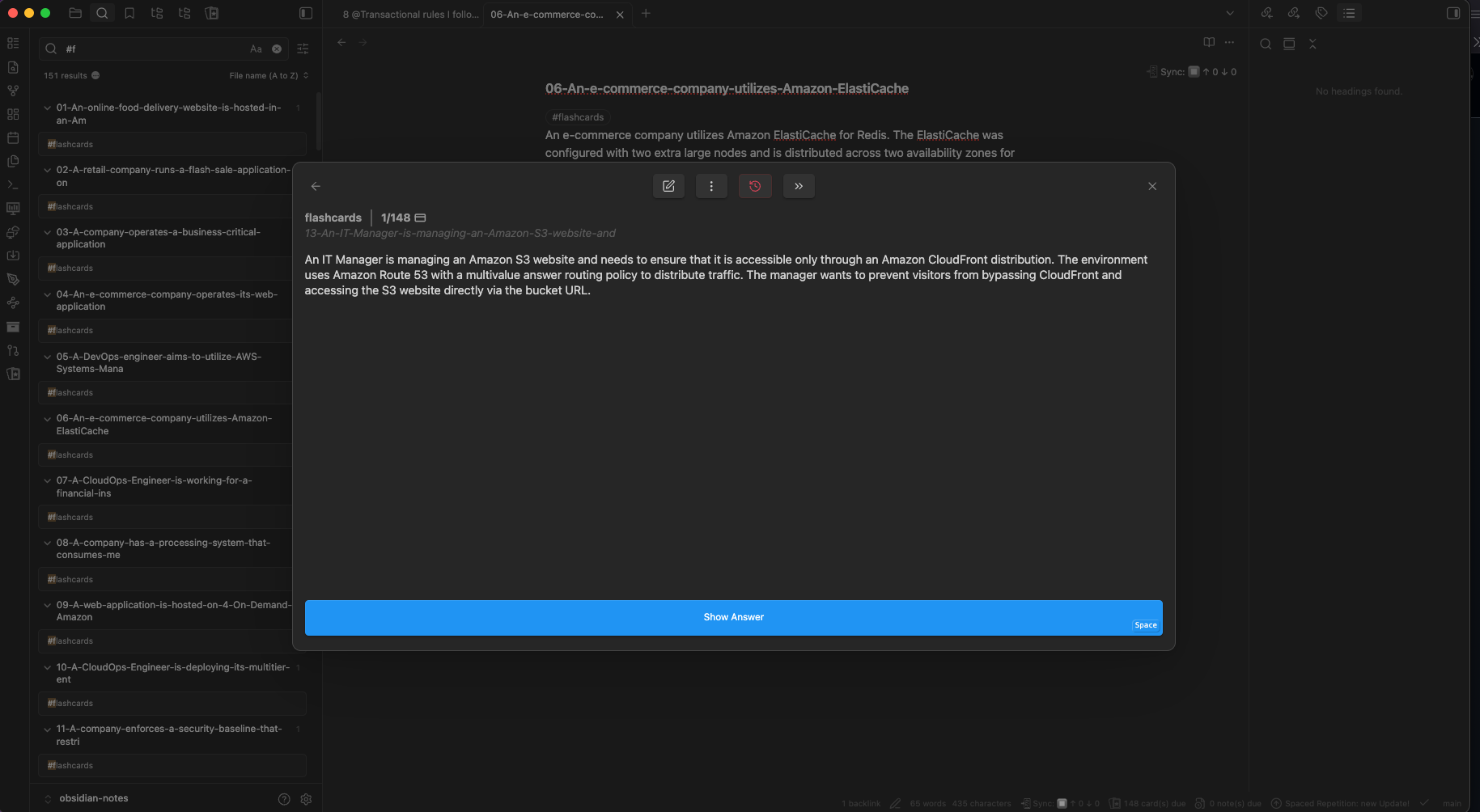
The cards use the obsidian-spaced-repetition plugin syntax — a question, a ? separator, and the answer:
#flashcards

An e-commerce company utilizes Amazon ElastiCache for Redis. The ElastiCache was
configured with two extra large nodes and is distributed across two availability
zones for redundancy. A recent analysis of the cluster's metrics found that it
operates with 60% freeable memory, suggesting it is overly provisioned.
?
Execute an online resizing for the ElastiCache for Redis cluster. Modify the node
types from extra-large to large nodes.
In Obsidian the plugin shows me the question first…
…then I reveal the answer and grade how well I knew it. Again / Hard / Good / Easy is what schedules the next review — the spaced-repetition engine doing its quiet, effective work:
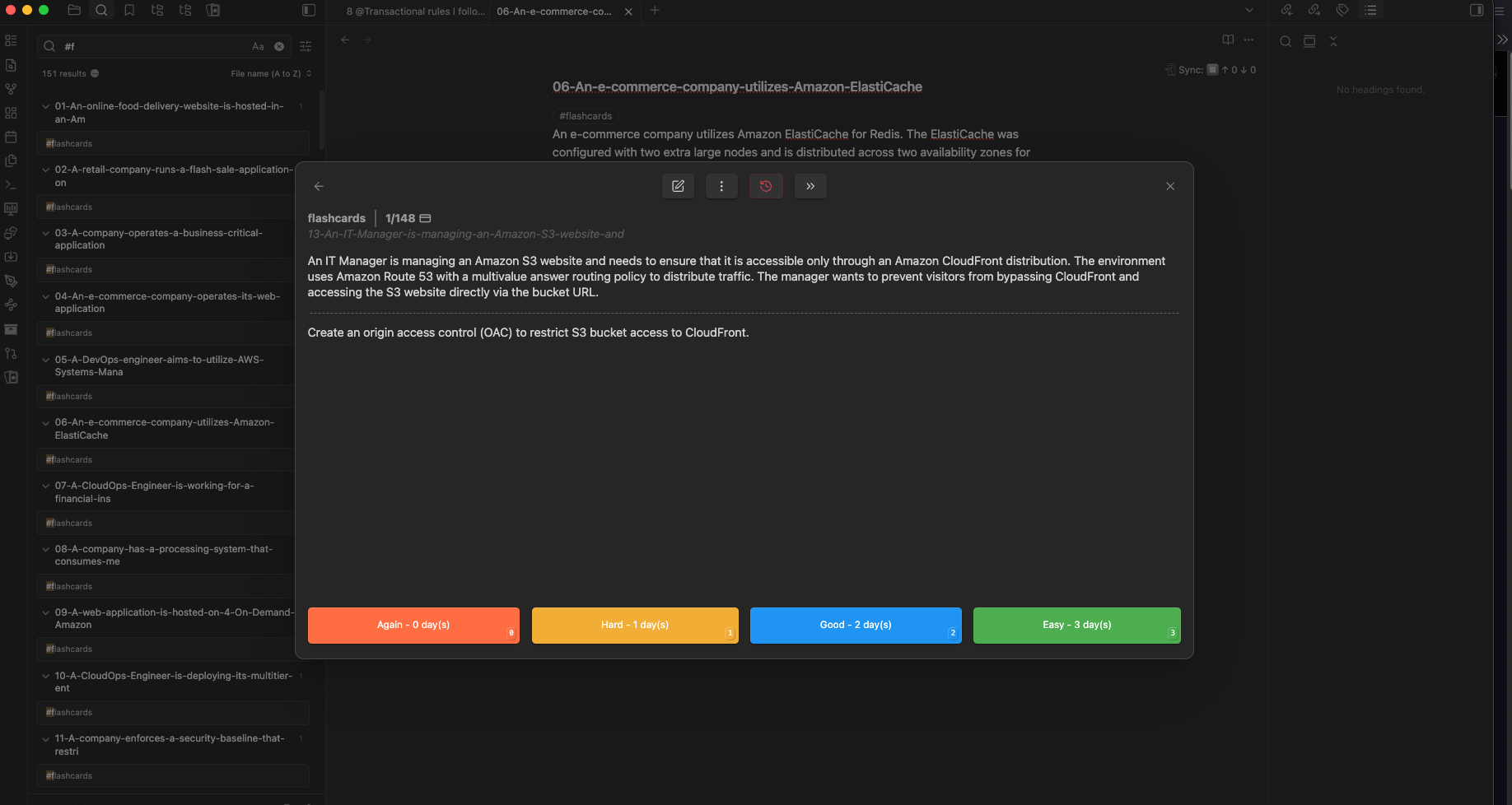
This is the whole basis of spaced repetition: I'd open a card, try to recall the answer from memory, and then — based on how hard it felt — the plugin would resurface that same card again some days later. Easy cards drift far apart; the ones I keep fumbling come back fast.
4. Results & an Honest Post-Mortem
- Passed SOA-C03 on the first attempt — 853 / 1000.
- My stack of wrong-question cards shrank week over week, because the system would not let me forget them.
- What actually earned the score: spaced repetition. Full stop. The course gave me the content; the flashcards gave me retention.
- What was honestly half just fun engineering: the extension and the nightly agent are genuinely useful, but a person with a Tutorials Dojo subscription and plain Anki would get most of the same benefit. I automated the review because automating things is how I think — and because removing friction is the difference between a habit I keep and one I abandon by week two.
- The one place I still spent real, deliberate time was reviewing the cards and digging into hard topics (KMS, k8s deployment strategies, cross-account access) with the Teach Skill. Everything else was automated.
So if you take one practical thing from this: find the most tedious part of your own studying and automate that — not the learning, the bookkeeping around the learning. For me that unlocked consistent spaced repetition, and consistency is the whole game.
5. Let's Talk
If you're building your own AI-assisted study loop, or you just want to argue about whether all this tooling beats a stack of Anki cards — reach out. I'm always up to trade notes on AI-driven learning. A deeper post with the full extension source and the agent job is coming next.